

Alexander Hamilton Institute - Waco Discusses American Statesmanship: Views from the Founding Period
The following account was written by Dr. Timothy Burns, President of AHI-Waco, about his participation in the annual conference. Attendees included Baylor faculty and students participating in an individual capacity.
The annual David and Mary Conference on the Great Books was held in Waco, Texas on October 23-24, 2026. W. David Clinton, Professor Emeritus at Baylor University, beloved teacher of so many Baylor students, and prominent international relations scholar, served as the discussion leader for its sessions. The conference discussed writings of Thomas Jefferson, John Jay, Alexander Hamilton, James Madison, and George Washington.
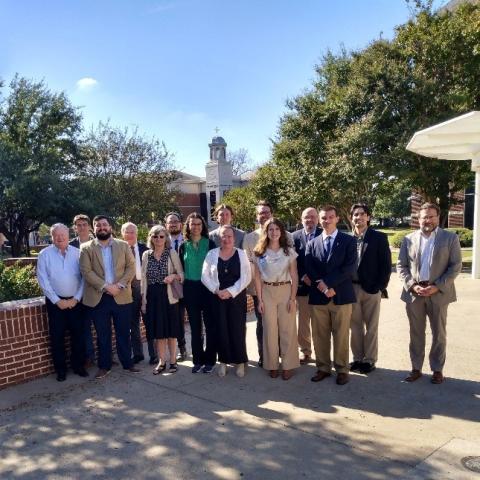
The conference was organized by AHI-Waco’s President, Timothy Burns. AHI-Waco is the offshoot of the Alexander Hamilton Institute for the Study of Western Civilization, located in Clinton, New York. In 2018, when the conference moved to Waco, Dr. Robert Paquette, Executive Director, President, and co-founder of the Alexander Hamilton Institute, named the annual conference after David and Mary Nichols, in honor of the two individuals who had been instrumental in organizing it for so many years.
The theme of the conference, the statesmanship of the founders, focused on the place of the new nation in the world of independent nations, including the defining factors that contributed to making Americans one people, the nation’s stance toward other nations, and the role of the institutions established by the Constitution not only in conducting its foreign affairs but in contributing to America’s self-understanding as a nation by doing so.
The first session of the conference was devoted to the Declaration of Independence, the principles that justified America’s assuming a separate and equal station among the nations of the world, and the conduct of Great Britain that violated its obligations to its American colonies. We then turned to several Federalist papers by John Jay, their less well-known author, who discussed the factors calling for union of the thirteen states, presenting a picture of the relations among states that made union advantageous as well as the propitious factors that united Americans as one people.
The conference also discussed Hamilton’s Federalist papers defending the Constitutional provisions concerning the conduct of foreign affairs. Hamilton traced the country’s needs for security, competence, and even maintenance of national character to the capacities of different institutions to fill those needs. Although Hamilton makes a good case for both the Constitution’s division and intermixtures of powers between the executive and legislative branches, difficult cases arise, as we saw when we discussed Hamilton’s and Madison’s conflicting reactions to George Washington’s Proclamation of Neutrality during the war between Britain and revolutionary France. Their exchanges (the Pacificus-Helvidius Debates) involved not only the respective powers of the executive and legislative branches in interpreting treaty obligations, but also the question of what one nation owes to another with regard to both law and justice. Our concluding text was Washington’s Farewell Address, the culminating advice that this consummate statesman left for his country, and the prospects he saw for its continuing security and happiness by remaining loyal to the Constitution and abiding by law and justice in both domestic and international affairs.
This year’s attendees included current Baylor graduate and undergraduate students, alums of the PhD program, several Baylor faculty, and other friends of AHI. After two days of sessions discussing our readings, the final dinner was held at the home of Mary Nichols, where we celebrated good conversation, good food, and good spirits. Singing around the campfire included several patriotic songs.
We are grateful to Professor Paquette for his continuing support of AHI-Waco and to the Jack Miller Center for Study of America’s Founding Principles and History, which also made this year’s conference possible.